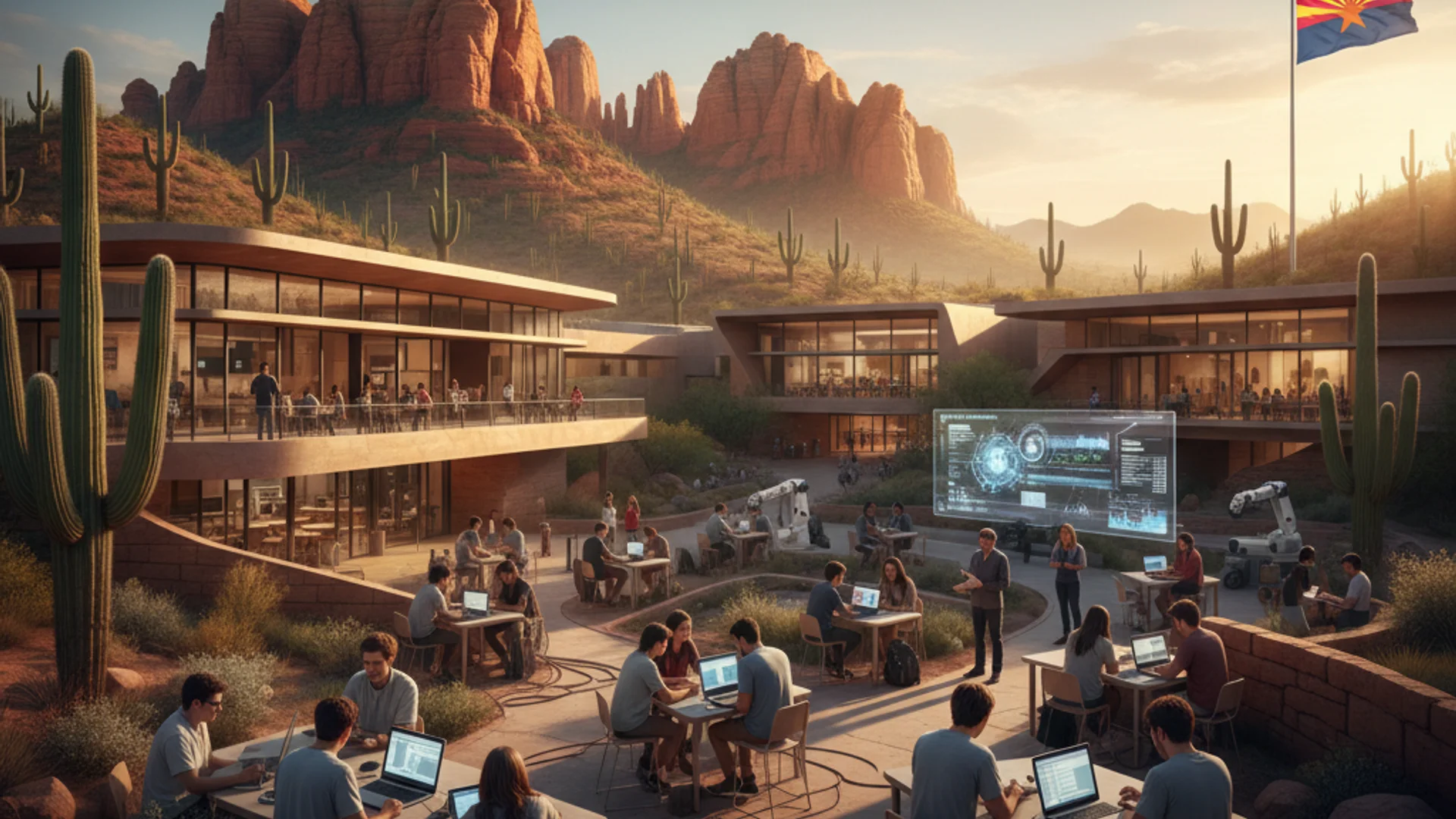
Top 3 Game Development Programs in Arizona
Arizona State University Campus Immersion
708 Game Development graduates annually, 81% graduation rate
University of Arizona
245 Game Development graduates annually, 68% graduation rate
Northern Arizona University
70 Game Development graduates annually, 98% graduation rate
- 1.Game Developers earn a median salary of $132,270 with 25% projected job growth through 2032 (BLS OEWS 2024)
- 2.Top-ranked Game Development programs include Arizona State University Campus Immersion, University of Arizona, Northern Arizona University based on graduation rates, program strength, and career outcomes
- 3.Best value: Arizona State University Campus Immersion offers Game Development education at $11,308/year with 81% graduation rate
- 4.9 accredited Game Development programs analyzed in Arizona using IPEDS 2023 completion data
Arizona Game Development Industry Overview
Arizona's game development industry has experienced remarkable growth, with the state now hosting over 50 gaming companies and employing approximately 2,400 professionals. The Phoenix metropolitan area serves as the primary hub, featuring major studios like Zynga, Com2uS, and independent developers creating everything from mobile games to AAA console titles.
The state's strategic advantages include a lower cost of living compared to traditional gaming hubs like California, favorable business climate, and proximity to major tech centers. Arizona offers a 10% tax credit for digital media production, including video game development, making it increasingly attractive for gaming companies to establish operations here.
Key gaming companies in Arizona include Hi-Rez Studios (creators of Smite and Paladins), Sandbox Interactive, and numerous mobile gaming startups. The presence of these companies creates direct pathways for graduates from local game development programs, with many offering internships and entry-level positions specifically for Arizona students.
According to the Entertainment Software Association, Arizona's gaming industry generates over $180 million annually in economic impact. The sector shows strong growth potential, with employment in computer and video game development projected to grow 15% through 2032, significantly faster than the national average of 8% for all occupations.
Complete Arizona Game Development Programs Rankings 2026
| 1 | Arizona State University Campus Immersion | Tempe, AZ | — | $11,308 | 81% | 75.2 |
| 2 | University of Arizona | Tucson, AZ | — | $11,546 | 68% | 57.8 |
| 3 | Northern Arizona University | Flagstaff, AZ | — | $11,015 | 98% | 51.9 |
| 4 | Grand Canyon University | Phoenix, AZ | — | $16,390 | 34% | 49 |
| 5 | American InterContinental University System | Chandler, AZ | — | $11,650 | — | 44.9 |
| 6 | University of Phoenix-Arizona | Phoenix, AZ | — | $9,552 | — | 42.6 |
| 7 | Arizona State University Digital Immersion | Scottsdale, AZ | — | $11,308 | — | 42.2 |
| 8 | University of Advancing Technology | Tempe, AZ | — | $18,462 | 74% | 42.1 |
| 9 | Embry-Riddle Aeronautical University-Prescott | Prescott, AZ | — | $40,680 | 82% | 41.4 |
Top 5 Game Development Programs in Arizona: Side-by-Side
| School | Arizona State University... | Arizona State University... | U of Arizona | Northern Arizona | Grand Canyon |
|---|---|---|---|---|---|
| Rank | #1 | #2 | #3 | #4 | #5 |
| In-State Tuition | $11,308 | $11,308 | $11,546 | $11,015 | $16,390 |
| Graduation Rate | 81% | N/A% | 68% | 98% | 34% |
| Annual Graduates | 708 | 362 | 245 | 79 | 140 |
| Acceptance Rate | 90% | 64% | 86% | 91% | 60% |
| Type | Public | Public | Public | Public | For-Profit |
| Score | 75.2/100 | 62.2/100 | 57.8/100 | 55.2/100 | 49.0/100 |
Best Bachelor's Degree Programs in Game Development in Arizona
Arizona offers 8 bachelor's-level game development programs. The top schools for undergraduate study are Arizona State University Campus Immersion, University of Arizona, Northern Arizona University. These programs prepare students for entry-level positions paying approximately $74,151 in the Arizona market.
A bachelor's in game development typically requires 120-128 credit hours and takes 4 years to complete. For national rankings, see our Best Game Development Bachelor's Programs guide.
Top 3 Game Development Bachelor's Programs in Arizona
| School | Tuition | Grad Rate | Graduates | Score |
|---|---|---|---|---|
| #1 Arizona State University... | $11,308 | 81% | 708 | 75.2 |
| #2 U of Arizona | $11,546 | 68% | 245 | 57.8 |
| #3 Northern Arizona | $11,015 | 98% | 70 | 54.5 |
Top Game Development Schools for Master's Degrees in Arizona
For graduate study, Arizona offers 6 master's-level game development programs. Leading institutions include Arizona State University Campus Immersion, Arizona State University Digital Immersion, Northern Arizona University. A master's degree can boost earning potential by 15-25%, with senior roles in Arizona reaching $137,709 or more.
Top 3 Game Development Master's Programs in Arizona
| School | Tuition | Grad Rate | Graduates | Score |
|---|---|---|---|---|
| #1 Arizona State University... | $11,308 | 81% | 742 | 75.2 |
| #2 Arizona State University... | $11,308 | N/A% | 362 | 62.2 |
| #3 Northern Arizona | $11,015 | 98% | 79 | 55.2 |
Most Affordable Game Development Colleges in Arizona
For budget-conscious students, the most affordable game development programs in Arizona are at Aspen University ($6,210/year), University of Phoenix-Arizona ($9,552/year), Northern Arizona University ($11,015/year). These programs offer strong ROI given Arizona's competitive tech salaries.
At Aspen University, a 4-year degree costs approximately $24,840 in tuition alone. With entry-level salaries around $74,151, graduates can typically recoup their investment within 0.6 years.
Most Affordable Game Development Programs in Arizona (with ROI)
| School | Annual Tuition | 4-Year Cost | Payback Period | Type |
|---|---|---|---|---|
| #1 Aspen | $6,210 | $24,840 | 0.6 years | For-Profit |
| #2 U of Phoenix-Arizona | $9,552 | $38,208 | 1 years | For-Profit |
| #3 Northern Arizona | $11,015 | $44,060 | 1.1 years | Public |
Game Development Program Types and Specializations in Arizona
Arizona universities offer diverse pathways into game development, ranging from traditional computer science degrees with gaming concentrations to specialized game design programs. Understanding these different approaches helps students choose the program that best aligns with their career goals and interests.
Bachelor's degree programs typically fall into four categories: Computer Science with Game Development focus (offered at ASU), dedicated Game Design degrees (University of Advancing Technology), Digital Arts and Game Art programs (Art Institute of Phoenix), and interdisciplinary Digital Culture programs that combine technical and creative elements.
- Programming-Focused Programs: Emphasize C++, C#, Unity, and Unreal Engine development
- Art and Design Programs: Focus on 3D modeling, animation, concept art, and visual effects
- Game Design Programs: Cover gameplay mechanics, level design, user experience, and project management
- Business and Production Programs: Prepare students for producer, project manager, and business development roles
Associate degree and certificate programs provide faster entry into the industry, typically focusing on specific skills like 2D/3D art, programming basics, or quality assurance testing. These programs often include portfolio development and industry networking opportunities that can lead directly to employment.
Many Arizona programs emphasize hands-on learning through game development studios, capstone projects, and collaboration with local gaming companies. Students often graduate with published games, professional portfolios, and industry connections that significantly improve their employment prospects in the competitive gaming industry.
Admission Requirements for Arizona Game Development Programs
Admission requirements vary significantly between institutions and program types. Public universities like Arizona State University typically require standard academic credentials, while specialized institutions may place greater emphasis on creative portfolios and demonstrated passion for gaming.
For bachelor's degree programs, most schools require a high school diploma with a minimum GPA of 2.5-3.0, SAT scores of 1000-1200 or ACT scores of 19-24, and completion of core academic subjects including four years of English, three years of mathematics, and two years of science. Some programs specifically require pre-calculus or calculus preparation.
- Portfolio Requirements: Art-focused programs typically require 10-15 pieces demonstrating drawing, digital art, or 3D modeling skills
- Programming Experience: Technical programs may require demonstration of basic programming knowledge or completion of coding assignments
- Personal Statement: Most programs require essays explaining interest in game development and career goals
- Letters of Recommendation: Usually 1-3 letters from teachers, employers, or mentors
Transfer students often have more flexible admission requirements, particularly at community colleges offering associate degrees or certificates. Many programs accept students without prior gaming experience, providing foundational courses in both technical and creative aspects of game development.
International students must meet additional requirements including TOEFL scores of 79-100 (iBT) or IELTS scores of 6.0-7.0, depending on the institution. Some programs offer conditional admission with intensive English language support for students who meet academic but not language requirements.
Arizona State University Campus Immersion
Tempe, AZ • Public
Program Highlights
- • Annual Tuition: $11,308 (in-state)
- • Graduation Rate: 81% (IPEDS 2023)
- • Game Development Graduates: 708 annually
- • Acceptance Rate: 90%
- • Ranking Score: 75.2 / 100
Program Strengths
- 81% graduation rate
- 708 game development graduates annually
- Public institution
- Overall score: 75.2 / 100
Why Ranked #1
Ranked #1 based on graduation rate (81%), program size (708 graduates), state salary outcomes ($105,930), and selectivity (90% acceptance rate). Data from IPEDS 2023 and BLS OES 2024.
Why Choose This Program
This interdisciplinary Bachelor of Science program combines hands-on game creation with cultural understanding of games, play, and interactive media, using industry embedded curriculum and new educational technology. The program sits at the intersection of advanced technology, cultural relevance and social impact, preparing students to create meaningful digital experiences that improve society in areas like healthcare and education.
Admissions
- Transfer Friendly
Available Specializations / Concentrations
Arizona State University Digital Immersion
Scottsdale, AZ • Public
Program Highlights
- • Annual Tuition: $11,308 (in-state)
- • Graduation Rate: N/A% (IPEDS 2023)
- • Game Development Graduates: 362 annually
- • Acceptance Rate: 64%
- • Ranking Score: 62.2 / 100
Program Strengths
- N/A% graduation rate
- 362 game development graduates annually
- Public institution
- Overall score: 62.2 / 100
Why Ranked #2
Ranked #2 based on graduation rate (N/A%), program size (362 graduates), state salary outcomes ($105,930), and selectivity (64% acceptance rate). Data from IPEDS 2023 and BLS OES 2024.
University of Arizona
Tucson, AZ • Public
Program Highlights
- • Annual Tuition: $11,546 (in-state)
- • Graduation Rate: 68% (IPEDS 2023)
- • Game Development Graduates: 245 annually
- • Acceptance Rate: 86%
- • Ranking Score: 57.8 / 100
Program Strengths
- 68% graduation rate
- 245 game development graduates annually
- Public institution
- Overall score: 57.8 / 100
Why Ranked #3
Ranked #3 based on graduation rate (68%), program size (245 graduates), state salary outcomes ($105,930), and selectivity (86% acceptance rate). Data from IPEDS 2023 and BLS OES 2024.
Northern Arizona University
Flagstaff, AZ • Public
Program Highlights
- • Annual Tuition: $11,015 (in-state)
- • Graduation Rate: 98% (IPEDS 2023)
- • Game Development Graduates: 79 annually
- • Acceptance Rate: 91%
- • Ranking Score: 55.2 / 100
Program Strengths
- 98% graduation rate
- 79 game development graduates annually
- Public institution
- Overall score: 55.2 / 100
Why Ranked #4
Ranked #4 based on graduation rate (98%), program size (79 graduates), state salary outcomes ($105,930), and selectivity (91% acceptance rate). Data from IPEDS 2023 and BLS OES 2024.
Why Choose This Program
The Immersive Media and Games program combines Computer Science, Art, and Visual Communications coursework to prepare students for careers as immersive media producers, game designers, software developers, and technical directors in gaming, visualization, and entertainment industries. The program emphasizes both technical skills in programming and artistic skills in 3D modeling, animation, and game asset creation.
Admission Prerequisites
- •MAT 121 or MAT 136 with a grade of C or better
Admissions
- Transfer Friendly
Program Details
- Credits: 120 credits
Grand Canyon University
Phoenix, AZ • For-Profit
Program Highlights
- • Annual Tuition: $16,390 (in-state)
- • Graduation Rate: 34% (IPEDS 2023)
- • Game Development Graduates: 140 annually
- • Acceptance Rate: 60%
- • Ranking Score: 49.0 / 100
Program Strengths
- 34% graduation rate
- 140 game development graduates annually
- For-Profit institution
- Overall score: 49.0 / 100
Why Ranked #5
Ranked #5 based on graduation rate (34%), program size (140 graduates), state salary outcomes ($105,930), and selectivity (60% acceptance rate). Data from IPEDS 2023 and BLS OES 2024.
Financial Aid and Scholarships for Game Development Students
Game development students in Arizona have access to multiple funding sources including federal financial aid, state grants, institutional scholarships, and industry-specific awards. Understanding these options early in the application process can significantly reduce education costs and debt burden.
All students should complete the Free Application for Federal Student Aid (FAFSA) to determine eligibility for federal Pell Grants, which provide up to $7,395 annually for eligible students, and federal student loans with favorable terms. Arizona residents may also qualify for state grants through the Arizona Financial Aid Trust (AFAT).
Many institutions offer merit-based scholarships specifically for STEM and technology students. ASU provides the New American University Scholarship covering full tuition for qualified students, while UAT offers industry partnership scholarships funded by gaming companies seeking talented graduates.
- Entertainment Software Association Foundation scholarships for underrepresented students in gaming
- Women in Games International scholarships for female students pursuing game development
- AMD scholarship programs for students in graphics and game programming
- Local tech company sponsorships and internship stipends
- Portfolio-based scholarships for demonstrating creative or technical excellence
Work-study programs and paid internships provide additional funding while building professional experience. Many Arizona gaming companies offer paid summer internships ranging from $15-25 per hour, with some providing housing assistance or transportation stipends for students from other cities.
Consider the total cost of education including living expenses, equipment, and software licenses. Some programs provide free or discounted access to industry-standard software like Unity Pro, Unreal Engine, and Adobe Creative Suite, which can save thousands of dollars annually compared to individual licensing.
Career Paths
Game Programmer
SOC 15-1254Develop game engines, gameplay systems, and user interfaces using languages like C++ and C#
Game Designer
SOC 15-1255Create game mechanics, level designs, and user experience systems for various gaming platforms
3D Artist
SOC 27-1014Design and create visual assets including characters, environments, and special effects
Quality Assurance Tester
SOC 15-1253Test games for bugs, balance issues, and user experience problems across multiple platforms
Game Producer
SOC 11-3031Manage development teams, budgets, and timelines for game projects from concept to launch
Other Tech Degree Programs in Arizona
Game Development Programs by Arizona Region
Phoenix Metro Area
Tucson Area
Northern Arizona
Rural Arizona
How to Choose the Right Game Development Program in Arizona
Selecting the right game development program requires careful consideration of your career goals, learning style, and financial situation. Different programs emphasize different aspects of game development, from highly technical programming-focused curricula to creative design-oriented approaches.
Students interested in programming and engine development should prioritize programs with strong computer science foundations, such as ASU's Digital Culture program or UAT's technical tracks. These programs provide deep knowledge of algorithms, data structures, and software engineering principles essential for backend and engine development roles.
Creative students passionate about visual design, storytelling, and user experience should consider art-focused programs that emphasize portfolio development, design principles, and industry-standard software training. Programs at Art Institute of Phoenix and Collins College provide hands-on experience with professional tools and creative processes.
- Evaluate curriculum alignment with career goals and industry demands
- Research faculty backgrounds and industry experience levels
- Examine available equipment, software, and development resources
- Investigate internship programs and industry partnership opportunities
- Consider program flexibility for working students or career changers
- Assess job placement rates and graduate success stories
Visit campuses when possible to experience lab facilities, meet current students, and observe the learning environment. Many programs offer preview days, portfolio review sessions, and information sessions that provide valuable insights into program culture and expectations. Consider speaking with recent graduates to understand real-world outcomes and industry preparation.
Choose Your Program Type
- You want comprehensive education with general studies requirements
- You're interested in research opportunities and graduate school preparation
- You value campus life and traditional college experience
- You need flexible scheduling for work or family commitments
- You want intensive, focused game development training
- You prefer hands-on learning over theoretical coursework
- You want direct industry connections and mentorship
- You're ready to commit fully to gaming career path
- You want affordable entry into game development
- You're changing careers and need practical skills quickly
- You plan to transfer to a four-year program later
- You want to test your interest before major commitment
Frequently Asked Questions About Arizona Game Development Programs
Based on 12 programs from IPEDS 2023, BLS OES May 2024
Game Development degree completions indicating program size, faculty, and resources
6-year completion rate from IPEDS 2023 (4-year institutions weighted higher)
Admission rate from IPEDS 2023 (lower = more selective)
State-specific game development salaries from BLS OES 2024
Explore Related Game Development Resources
Data Sources and Methodology
Employment projections and salary data for gaming industry occupations
Institutional characteristics, enrollment, and graduation rate data
Student outcome metrics and financial aid information
Industry reports and market analysis for video game sector
Source: U.S. Bureau of Labor Statistics

Taylor Rupe
Full-Stack Developer (B.S. Computer Science, B.A. Psychology)
Taylor combines formal training in computer science with a background in human behavior to evaluate complex search, AI, and data-driven topics. His technical review ensures each article reflects current best practices in semantic search, AI systems, and web technology.