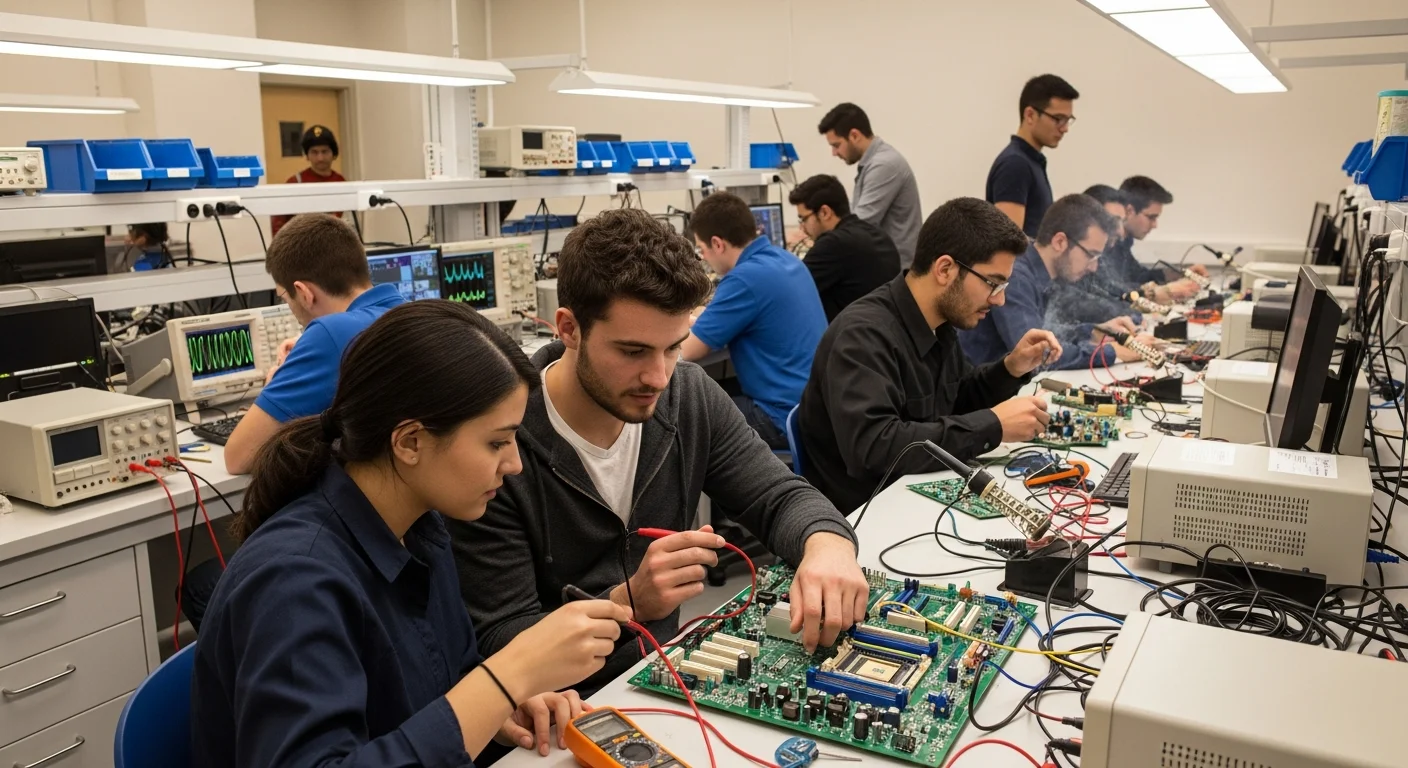
- 1.Hakia ranks the best computer engineering degree programs in 2026, computer engineering professionals earn a median salary of $137,890/year, with 7% job growth projected through 2032, steady growth.
- 2.Our top-ranked computer engineering programs are University of Illinois Urbana-Champaign, Purdue University-Main Campus, and New York University, selected based on graduation rates, program size, and career outcomes.
- 3.Best value: University of Central Florida offers computer engineering degrees at just $4,478/year with a 93% graduation rate.
- 4.284 accredited computer engineering programs available nationwide, with options at every degree level from associate's to doctoral.
- 5.Entry-level positions require a bachelor's degree. Master's degrees unlock senior roles with 20-40% higher salaries and leadership opportunities.
Source: Computer engineering offers excellent career prospects with $128,170 median salary and growing demand in IoT, AI hardware, and autonomous systems. Best for students interested in both hardware and software with strong math/physics skills. Pure software careers may prefer computer science programs.
Best Computer Engineering Programs - Top 10
These are the best computer engineering programs in the United States based on our comprehensive methodology that considers graduation rates, program size, institutional reputation, and career outcomes. Rankings are updated annually using data from IPEDS and BLS.
Best Computer Engineering Programs - Top 10
University of Illinois Urbana-Champaign
Doctoral: Very High Research (R1)
Illinois ECE operates one of the country's largest and most sophisticated university facilities for nanotechnology research through the Holonyak Lab, while offering a unique fully-online professional Master of Engineering that maintains the same academic rigor as the on-campus program.
University of Illinois Urbana-Champaign Computer Engineering Program Overview
Hakia ranks University of Illinois Urbana-Champaign as the #1 in computer engineering degree program.
University of Illinois Urbana-Champaign's Computer Engineering program graduates 396 students annually with a 90% graduation rate. Research opportunities include the Coordinated Science Laboratory and Holonyak Micro & Nanotechnology Laboratory. Access to Materials Research Laboratory Graduates find positions at Intel Corporation, Meta, Google.
Hakia Insight: University of Illinois Urbana-Champaign graduates earn $85,000, driven by the program's industry connections and hands-on computer engineering curriculum.
Degree Programs
Research Labs & Institutes
Premier multidisciplinary research laboratory focusing on information technology at the crossroads of circuits, computing, control, and communications
One of the country's largest and most sophisticated university facilities for photonics, microelectronics, biotechnology, and nanotechnology research
Advanced science and technology research with cross-departmental faculty appointments
Location Advantages
- •Access to Materials Research Laboratory
- •Proximity to major tech companies through alumni network
- •Integration with Grainger College of Engineering's research ecosystem
Industry Partners
Career Outcomes
Intel Corporation, Meta, Google, Amazon, Microsoft
Certifications & Designations
Admissions
Purdue University-Main Campus
Doctoral: Very High Research (R1)
Purdue ECE launched the nation's first comprehensive semiconductor degrees program to address the critical need for 50,000 trained semiconductor engineers within five years, positioning graduates at the forefront of America's semiconductor industry resurgence in the emerging Silicon Heartland.
Purdue University-Main Campus Computer Engineering Program Overview
Hakia ranks Purdue University-Main Campus as the #2 in computer engineering degree program.
Purdue University-Main Campus's Computer Engineering program graduates 319 students annually with a 83% graduation rate. Research opportunities include the Birck Nanotechnology Center and Ray W. Herrick Laboratories. Silicon Heartland semiconductor industry development Graduates find positions at Amazon, Apple, Intel Corporation.
Hakia Insight: Purdue University-Main Campus's industry network, including Amazon and Apple, provides students with internship and hiring pathways.
Degree Programs
Research Labs & Institutes
Advanced nanotechnology research and fabrication
Advanced engineering research
Aerospace and propulsion research
Location Advantages
- •Silicon Heartland semiconductor industry development
- •West Lafayette and Indianapolis campuses for flexibility
- •Strong Midwest manufacturing and technology corridor
Industry Partners
Career Outcomes
Amazon, Apple, Intel Corporation, General Motors, Texas Instruments
Certifications & Designations
Admissions
New York University
Doctoral: Very High Research (R1)
NYU Tandon's Computer Engineering program uniquely combines advanced research in quantum computing, cybersecurity, and robotics with direct industry collaboration, housed within one of the nation's most comprehensive engineering schools in the heart of New York's innovation corridor.
New York University Computer Engineering Program Overview
Hakia ranks New York University as the #3 in computer engineering degree program.
New York University offers comprehensive Computer Engineering programs at multiple degree levels, combining rigorous academics with practical experience. Research opportunities include the Center for Cyber Security and Center for Artificial Intelligence and Robotics. Brooklyn tech corridor access
Hakia Insight: Through ties with Intel and Department of Defense, New York University bridges the gap between academic training and industry practice.
Degree Programs
Research Labs & Institutes
Hardware security, cryptography, and information security research center
Fundamental research in AI and robotics with multi-agent systems and deep learning applications
Quantum technologies and advanced materials research
Location Advantages
- •Brooklyn tech corridor access
- •NYC startup ecosystem proximity
- •Direct connections to Wall Street financial technology sector
Industry Partners
Career Outcomes
Certifications & Designations
Admissions
University of Washington-Seattle Campus
Doctoral: Very High Research (R1)
UW's Computer Engineering program uniquely combines the resources of two top-20 ranked departments, offering students access to advanced research facilities like the Washington Nanofabrication Facility while being embedded in Seattle's tech capital with direct pipelines to Amazon, Microsoft, and Boeing.
University of Washington-Seattle Campus Computer Engineering Program Overview
Hakia ranks University of Washington-Seattle Campus as the #4 in computer engineering degree program.
University of Washington-Seattle Campus's Computer Engineering program graduates 40 students annually with a 97% graduation rate. Research opportunities include the CHIPS at UW ECE and Washington Nanofabrication Facility. Located in Seattle's tech corridor with proximity to Amazon, Microsoft, and hundreds of tech companies Graduates find positions at Amazon, Boeing, Microsoft.
Hakia Insight: Students at University of Washington-Seattle Campus benefit from active collaborations with Amazon and Microsoft, connecting classroom learning to the workforce.
Degree Programs
Research Labs & Institutes
Semiconductor and integrated circuit research
Advanced materials and device fabrication
Human-computer collaboration and educational gaming
Neural engineering and brain-computer interfaces
Location Advantages
- •Located in Seattle's tech corridor with proximity to Amazon, Microsoft, and hundreds of tech companies
- •Access to vibrant startup ecosystem and venture capital community
- •Strong regional tech industry presence including Boeing aerospace engineering
Industry Partners
Career Outcomes
Amazon, Boeing, Microsoft, Meta, University of Washington
Certifications & Designations
Admissions
University of California-San Diego
Doctoral: Very High Research (R1)
UCSD CSE stands out as one of the few programs offering both Computer Science and Computer Engineering master's degrees with three distinct plan options, including a unique Comprehensive Interdisciplinary Plan that formally integrates coursework from other departments, housed within a school that has launched 14 advanced research centers since 2014.
University of California-San Diego Computer Engineering Program Overview
Hakia ranks University of California-San Diego as the #5 in computer engineering degree program.
University of California-San Diego's Computer Engineering program graduates 174 students annually with a 81% graduation rate. Research opportunities include the Center for Machine-Intelligence, Computing and Security and Center for Networked Systems. La Jolla campus proximity to San Diego tech corridor
Hakia Insight: University of California-San Diego's Contextual Robotics Institute and Information Theory and Applications Center position students at the forefront of computer engineering research.
Degree Programs
Research Labs & Institutes
AI security and computational intelligence research
Network architecture and distributed systems
Computer vision and graphics research
AI-driven robotics and autonomous systems
Theoretical foundations of information processing
Location Advantages
- •La Jolla campus proximity to San Diego tech corridor
- •Access to Jacobs School's 14 specialized research centers
- •Integration with UC San Diego's broader research ecosystem
Career Outcomes
Admissions
Ohio State University-Main Campus
Doctoral: Very High Research (R1)
Ohio State CSE operates one of the largest university cybersecurity research institutes in the nation through ICDT, while maintaining over 50 years of continuous innovation in computer engineering education with direct industry partnerships through the Ohio Manufacturing Institute and Honda-Ohio State Partnership.
Ohio State University-Main Campus Computer Engineering Program Overview
Hakia ranks Ohio State University-Main Campus as the #6 in computer engineering degree program.
Ohio State University-Main Campus's Computer Engineering program graduates 455 students annually with a 90% graduation rate. Research opportunities include the Research Laboratories, Centers, and Institutes and ElectroScience Laboratory. Columbus tech corridor with major corporate presence
Hakia Insight: Ohio State University-Main Campus's industry network, including Honda and Ohio Manufacturing Institute, provides students with internship and hiring pathways.
Degree Programs
Research Labs & Institutes
Various ECE research areas
Electromagnetics and wireless systems
Power electronics and energy systems
Cybersecurity and digital systems
Advanced sensor development
Device fabrication and characterization
Nanoscale electronics
Power system management
Semiconductor materials
Autonomous systems
Transportation systems
Optical systems
Infrared detection systems
Location Advantages
- •Columbus tech corridor with major corporate presence
- •Strong state government and defense contractor connections
- •Access to Ohio's manufacturing and automotive industry base
Industry Partners
Career Outcomes
Certifications & Designations
Admissions
University of California-Irvine
Doctoral: Very High Research (R1)
UC Irvine's Computer Engineering program is highly customizable to student interests and benefits from proximity to major tech companies, with graduates achieving an average starting salary of $73,850 according to alumni tracking data.
University of California-Irvine Computer Engineering Program Overview
Hakia ranks University of California-Irvine as the #7 in computer engineering degree program.
University of California-Irvine's Computer Engineering program graduates 191 students annually with a 96% graduation rate. Research opportunities include the Center for Embedded Computer Systems (CECS) and Integrated Nanosystems Research Facility (INRF). Orange County tech corridor with proximity to major aerospace and technology companies Graduates find positions at Northrop Grumman, Boeing, Applied Medical.
Hakia Insight: University of California-Irvine's industry network, including Northrop Grumman and Boeing, provides students with internship and hiring pathways.
Degree Programs
Research Labs & Institutes
Leading-edge interdisciplinary research in embedded systems, automotive, medical and communications applications
cleanroom for micro- and nanosystems research and development
Information processing capabilities of biological visual systems and computational vision systems
Location Advantages
- •Orange County tech corridor with proximity to major aerospace and technology companies
- •Close to Silicon Valley and Los Angeles tech hubs
- •Strong connections to Southern California defense contractors
Industry Partners
Career Outcomes
Northrop Grumman, Boeing, Applied Medical, Southern California Edison, Medtronic
Certifications & Designations
Admissions
University of Southern California
Doctoral: Very High Research (R1)
USC's Computer Engineering program uniquely combines advanced VLSI design with advanced computer architecture research, while offering identical on-campus and online degree experiences through the pioneering DEN@Viterbi distance education network.
University of Southern California Computer Engineering Program Overview
Hakia ranks University of Southern California as the #8 in computer engineering degree program.
University of Southern California's Computer Engineering program graduates 79 students annually with a 92% graduation rate. Research opportunities include the Computer Graphics Group and Robotics and Autonomous Systems Center (RASC). Los Angeles tech ecosystem access Graduates find positions at Apple, NVIDIA, Qualcomm.
Hakia Insight: Students at University of Southern California benefit from active collaborations with Intel and NVIDIA, connecting classroom learning to the workforce.
Degree Programs
Research Labs & Institutes
Interactive techniques and simulation of multimedia and 3D content
Human-centric and scalable robotic systems
Autonomous systems and distributed computing
Location Advantages
- •Los Angeles tech ecosystem access
- •Strong connections to major semiconductor and tech companies
- •Proximity to entertainment and aerospace industries
Industry Partners
Career Outcomes
Apple, NVIDIA, Qualcomm, Intel, Google
Certifications & Designations
Admissions
University of Michigan-Ann Arbor
Doctoral: Very High Research (R1)
Michigan's Computer Engineering program uniquely combines access to six specialized research laboratories with deep integration into the university's broader computational institutes, creating an ecosystem where students work alongside researchers tackling everything from chip-level design to warehouse-scale computing systems.
University of Michigan-Ann Arbor Computer Engineering Program Overview
Hakia ranks University of Michigan-Ann Arbor as the #9 in computer engineering degree program.
University of Michigan-Ann Arbor's Computer Engineering program graduates 132 students annually with a 92% graduation rate. Research opportunities include the Center for Dynamic Magneto-Optics (DYNAMO) and Gérard Mourou Center for Ultrafast Optical Science (CUOS). Access to Michigan's top-tier engineering college resources
Hakia Insight: University of Michigan-Ann Arbor's Gérard Mourou Center for Ultrafast Optical Science (CUOS) creates a direct research-to-career pipeline with Applications Driving Architectures (ADA) Center, bridging academic research and industry practice.
Degree Programs
Research Labs & Institutes
Dynamic magneto-optical systems
Ultrafast optical science
Wireless integrated microsensing systems
Quantum engineering and technology
Integrated circuits research
Neurotechnology research
Power and energy systems
Optics and photonics research
Radiation and electromagnetic research
Nanofabrication research
Location Advantages
- •Access to Michigan's top-tier engineering college resources
- •Integration with university-wide computational institutes
- •Strong alumni network in tech industry
Industry Partners
Career Outcomes
Admissions
University of California-Merced
Doctoral: High Research (R2)
UC Merced's EECS graduate program broke into the top 100 national rankings for computer engineering in 2025 - a remarkable achievement for a campus barely 20 years old, demonstrating the program's rapid ascension in research excellence and industry recognition.
University of California-Merced Computer Engineering Program Overview
Hakia ranks University of California-Merced as the #10 in computer engineering degree program.
University of California-Merced's Computer Engineering program graduates 217 students annually with a 95% graduation rate. Research opportunities include the Big Data Systems and Analytics Lab and Computer Networks Research Group. Proximity to Silicon Valley tech corridor
Hakia Insight: University of California-Merced's direct partnerships with Lawrence Livermore National Laboratory and IBM give students a competitive edge through industry-embedded projects and recruiting pipelines.
Degree Programs
Research Labs & Institutes
Scientific data processing, multi-dimensional array management, infrastructure for big data analytics
Solar infrastructure measurement, search and rescue operations in infrastructure-deficient environments
Cooperative multi-robot systems, map merging, pursuit-evasion games
Virtual reality, applied artificial intelligence, effective computer system interaction
Location Advantages
- •Proximity to Silicon Valley tech corridor
- •Access to Lawrence Livermore National Laboratory
- •Gateway to Yosemite National Park providing unique research opportunities
Industry Partners
Career Outcomes
Certifications & Designations
Admissions
Best Computer Engineering Programs - Top 10 — Complete Program Data
#1. University of Illinois Urbana-Champaign Computer Engineering Program
Hakia ranks University of Illinois Urbana-Champaign as the #1 in computer engineering degree program. Location: Champaign, IL | Type: Public | Tuition: $14,768/year | Graduation Rate: 90% | Score: 91.1
What makes University of Illinois Urbana-Champaign stand out: Illinois ECE operates one of the country's largest and most sophisticated university facilities for nanotechnology research through the Holonyak Lab, while offering a unique fully-online professional Master of Engineering that maintains the same academic rigor as the on-campus program.
Hakia Insight: University of Illinois Urbana-Champaign graduates earn $85,000, driven by the program's industry connections and hands-on computer engineering curriculum.
Program Overview: The University of Illinois Urbana-Champaign's Computer Engineering program operates within the Department of Electrical & Computer Engineering, offering three distinct graduate pathways: a research-focused MS degree (32 credit hours with thesis), a professional Master of Engineering (M.Eng.) available both on-campus and fully online (32 credit hours, coursework-only), and a comprehensive PhD program. The M.Eng. is particularly innovative as a self-supported professional degree designed for working engineers, with the online version allowing completion at your own pace over five years. Students can specialize across seven focus areas including Machine Learning & AI, Robotics & Cyber-Physical Systems, and Computer Architecture. The program leverages Illinois's research infrastructure including the Coordinated Science Laboratory, Holonyak Micro & Nanotechnology Laboratory, and the Beckman Institute for Advanced Science and Technology, where faculty hold cross-appointments enabling interdisciplinary research opportunities.
Degree Programs: MS in Electrical and Computer Engineering (2 years); Master of Engineering (M.Eng.) (2-3 semesters); Master of Engineering Online (M.Eng.) (Up to 5 years); PhD in Electrical and Computer Engineering (4-6 years)
Research Labs: Coordinated Science Laboratory - Premier multidisciplinary research laboratory focusing on information technology at the crossroads of circuits, computing, control, and communications; Holonyak Micro & Nanotechnology Laboratory - One of the country's largest and most sophisticated university facilities for photonics, microelectronics, biotechnology, and nanotechnology research; Beckman Institute for Advanced Science and Technology - Advanced science and technology research with cross-departmental faculty appointments
Industry Partners: Intel Corporation, Meta, Google, Boeing, Cadence
Career Outcomes: Placement Rate: 94% secured first destination | Top Employers: Intel Corporation, Meta, Google, Amazon, Microsoft, Tesla, Boeing | Common Roles: Software Engineer, SOC Design Engineer, Hardware Systems Engineer, Research Scientist
Notable Faculty: Bruce Hajek (Department Head); Sayan Mitra (Director of Graduate Studies)
Admissions: GPA: 3.0 minimum, but applicants with GPAs below 3.5 are rarely admitted due to space limitations
Accreditations: ABET Accredited for Computer Engineering, ABET Accredited for Electrical Engineering
#2. Purdue University-Main Campus Computer Engineering Program
Hakia ranks Purdue University-Main Campus as the #2 in computer engineering degree program. Location: West Lafayette, IN | Type: Public | Tuition: $9,718/year | Graduation Rate: 83% | Score: 84.2
What makes Purdue University-Main Campus stand out: Purdue ECE launched the nation's first comprehensive semiconductor degrees program to address the critical need for 50,000 trained semiconductor engineers within five years, positioning graduates at the forefront of America's semiconductor industry resurgence in the emerging Silicon Heartland.
Hakia Insight: Purdue University-Main Campus's industry network, including Amazon and Apple, provides students with internship and hiring pathways.
Program Overview: Purdue University's Elmore Family School of Electrical and Computer Engineering offers a comprehensive Computer Engineering program through both undergraduate and graduate pathways. The undergraduate Bachelor of Science in Computer Engineering is ranked #10 nationally by U.S. News & World Report, with graduates earning an average starting salary of $91,948 within six months. Students can pursue their studies at both West Lafayette and Indianapolis campuses, with first-year engineering students in West Lafayette building foundational skills before transitioning to their specialty major in the second year. At the graduate level, Purdue offers multiple Master of Science in Electrical and Computer Engineering (MSECE) tracks, including a fully online program ranked #1 by U.S. News & World Report for 2025. The program serves working professionals through flexible, asynchronous coursework while maintaining the same rigorous curriculum and faculty as on-campus programs. Students can specialize in areas including Computer Engineering, Artificial Intelligence and Machine Learning, Communications and Signal Processing, Microelectronics and Nanotechnology, and emerging fields like quantum computing and IoT. The school houses over 3,800 undergraduate and graduate students with 135 faculty members, supported by extensive research facilities including the Birck Nanotechnology Center.
Degree Programs: BS Computer Engineering (4 years); MSECE Professional Master's (2 years); MSECE Online (24 months); MSECE Thesis Track (2 years); 4+1 BS/MSECE (5 years total); PhD in Electrical and Computer Engineering (4-6 years)
Research Labs: Birck Nanotechnology Center - Advanced nanotechnology research and fabrication; Ray W. Herrick Laboratories - Advanced engineering research; Maurice J. Zucrow Laboratories - Aerospace and propulsion research
Industry Partners: Amazon, Apple, Intel Corporation, General Motors, Texas Instruments Inc., JPMorgan Chase & Co., John Deere
Career Outcomes: Placement Rate: High placement within six months | Top Employers: Amazon, Apple, Intel Corporation, General Motors, Texas Instruments, JPMorgan Chase, John Deere, BAE Systems, Cummins Inc. | Common Roles: Hardware Engineer, Software Developer, Cybersecurity Analyst, Network Engineer, Robotics Engineer, Game Developer, Technical Product Manager, Semiconductor Engineer
Notable Faculty: David Inderrieden (Analog and mixed-signal circuit design); Mireille Boutin (Digital signal processing and embedded systems)
Admissions:
Accreditations: ABET Accredited
#3. New York University Computer Engineering Program
Hakia ranks New York University as the #3 in computer engineering degree program. Location: New York, NY | Type: Private | Tuition: $60,438/year | Score: 80.6
What makes New York University stand out: NYU Tandon's Computer Engineering program uniquely combines advanced research in quantum computing, cybersecurity, and robotics with direct industry collaboration, housed within one of the nation's most comprehensive engineering schools in the heart of New York's innovation corridor.
Hakia Insight: Through ties with Intel and Department of Defense, New York University bridges the gap between academic training and industry practice.
Program Overview: NYU Tandon's Master of Science in Computer Engineering positions students at the advanced of telecommunications, networks, and microelectronics industries through a program that bridges hardware and software innovation. Under the direction of Professor Ramesh Karri, who also serves as department chair, the program emphasizes practical experience alongside theoretical foundations in areas ranging from VLSI verification and embedded systems design to computer architecture. The program offers remarkable flexibility with specialized tracks in Artificial Intelligence, Software, and Robotics, allowing students to customize their studies around emerging technologies like deep learning, autonomous systems, and network design. Students gain hands-on experience through collaborative relationships with industry and government agencies, while the program's location in Brooklyn provides access to NYC's thriving tech ecosystem.
Degree Programs: MS in Computer Engineering (2 years)
Research Labs: Center for Cyber Security - Hardware security, cryptography, and information security research center; Center for Artificial Intelligence and Robotics - Fundamental research in AI and robotics with multi-agent systems and deep learning applications; Nanofabrication Cleanroom - Quantum technologies and advanced materials research
Industry Partners: Intel, Department of Defense, National Science Foundation
Career Outcomes: | Common Roles: Computer Design Engineer, Systems Architecture Engineer, Embedded Systems Developer, Network Engineer, Software Applications Developer
Notable Faculty: Dr. Ramesh Karri (Computer engineering, cybersecurity, hardware security)
Admissions:
Accreditations: ABET
#4. University of Washington-Seattle Campus Computer Engineering Program
Hakia ranks University of Washington-Seattle Campus as the #4 in computer engineering degree program. Location: Seattle, WA | Type: Public | Tuition: $11,524/year | Graduation Rate: 97% | Score: 79.9
What makes University of Washington-Seattle Campus stand out: UW's Computer Engineering program uniquely combines the resources of two top-20 ranked departments, offering students access to advanced research facilities like the Washington Nanofabrication Facility while being embedded in Seattle's tech capital with direct pipelines to Amazon, Microsoft, and Boeing.
Hakia Insight: Students at University of Washington-Seattle Campus benefit from active collaborations with Amazon and Microsoft, connecting classroom learning to the workforce.
Program Overview: The University of Washington-Seattle Campus Computer Engineering program operates through two prestigious departments: the Paul G. Allen School of Computer Science & Engineering and the Department of Electrical & Computer Engineering. The program offers undergraduate Bachelor of Science in Computer Engineering degrees through the College of Engineering, featuring extensive research opportunities across artificial intelligence, robotics, systems design, and quantum technologies. Located in Seattle's thriving tech ecosystem, students benefit from proximity to Amazon, Microsoft, Boeing, and a vibrant startup community. The program emphasizes both theoretical foundations and hands-on experience through state-of-the-art facilities including the Paul G. Allen Center and access to specialized labs like the Washington Nanofabrication Facility and various research centers focusing on everything from biosystems to quantum systems.
Degree Programs: Bachelor of Science in Computer Engineering (4 years); Master of Science in Electrical Engineering (Computer Engineering focus) (1.5-2 years); Doctor of Philosophy in Computer Engineering (4-6 years)
Research Labs: CHIPS at UW ECE - Semiconductor and integrated circuit research; Washington Nanofabrication Facility - Advanced materials and device fabrication; Center for Game Science - Human-computer collaboration and educational gaming; Center for Neurotechnology - Neural engineering and brain-computer interfaces
Industry Partners: Amazon, Microsoft, Boeing, Intel, Apple
Career Outcomes: Placement Rate: 85% positive outcome rate within 6 months | Top Employers: Amazon, Boeing, Microsoft, Meta, University of Washington | Common Roles: Software Engineer/Software Development Engineer, Electrical Engineer, Project Engineer, Engineer
Notable Faculty: Luis Ceze (Computer architecture, DNA storage, machine learning systems); Zachary Tatlock (Programming languages, formal verification, hardware design); Shyamnath Gollakota (Wireless systems, IoT, ambient computing)
Admissions: GPA: Minimum 2.0 in required courses | Acceptance Rate: Highly competitive, capacity constrained
Accreditations: ABET Accredited Computer Engineering Program
#5. University of California-San Diego Computer Engineering Program
Hakia ranks University of California-San Diego as the #5 in computer engineering degree program. Location: La Jolla, CA | Type: Public | Tuition: $11,834/year | Graduation Rate: 81% | Score: 79.2
What makes University of California-San Diego stand out: UCSD CSE stands out as one of the few programs offering both Computer Science and Computer Engineering master's degrees with three distinct plan options, including a unique Comprehensive Interdisciplinary Plan that formally integrates coursework from other departments, housed within a school that has launched 14 advanced research centers since 2014.
Hakia Insight: University of California-San Diego's Contextual Robotics Institute and Information Theory and Applications Center position students at the forefront of computer engineering research.
Program Overview: UC San Diego's Computer Science and Engineering department offers Master of Science degrees in both Computer Science and Computer Engineering, designed with remarkable flexibility to serve diverse post-graduate needs. Students can choose from three distinct pathways: a Thesis Plan for research-focused students, a Comprehensive Standard Plan, or a Comprehensive Interdisciplinary Plan that integrates coursework from other departments. The program accommodates both full-time students and working professionals through part-time enrollment options, with a structured curriculum emphasizing fundamental concepts, breadth across multiple domains, and deep specialization in chosen areas. The department's approach ensures students gain exposure to fundamental concepts and tools, advanced perspectives in areas outside their specialization through the Breadth requirement covering Theory, Systems, and Applications, and deep expertise in their chosen research area through the Depth requirement. The program maintains rigorous academic standards with a minimum 3.0 GPA requirement and specific grade requirements for core coursework. Students benefit from the department's integration within the broader Jacobs School of Engineering, which houses numerous research centers launched since 2014, including specialized institutes focused on machine intelligence, microbiome innovation, and contextual robotics.
Degree Programs: MS in Computer Science and Engineering - Thesis Plan (Minimum 3 quarters); MS in Computer Science and Engineering - Comprehensive Standard Plan (Minimum 3 quarters); MS in Computer Science and Engineering - Comprehensive Interdisciplinary Plan (Minimum 3 quarters); MS in Computer Science and Engineering (Computer Engineering) (Minimum 3 quarters)
Research Labs: Center for Machine-Intelligence, Computing and Security - AI security and computational intelligence research; Center for Networked Systems - Network architecture and distributed systems; Center for Visual Computing - Computer vision and graphics research; Contextual Robotics Institute - AI-driven robotics and autonomous systems; Information Theory and Applications Center - Theoretical foundations of information processing
Career Outcomes:
Admissions: GPA: 3.0 minimum overall GPA required for good standing
#6. Ohio State University-Main Campus Computer Engineering Program
Hakia ranks Ohio State University-Main Campus as the #6 in computer engineering degree program. Location: Columbus, OH | Type: Public | Tuition: $11,826/year | Graduation Rate: 90% | Score: 78.1
What makes Ohio State University-Main Campus stand out: Ohio State CSE operates one of the largest university cybersecurity research institutes in the nation through ICDT, while maintaining over 50 years of continuous innovation in computer engineering education with direct industry partnerships through the Ohio Manufacturing Institute and Honda-Ohio State Partnership.
Hakia Insight: Ohio State University-Main Campus's industry network, including Honda and Ohio Manufacturing Institute, provides students with internship and hiring pathways.
Program Overview: Ohio State University's Computer Engineering program operates through the Department of Computer Science and Engineering (CSE) within the College of Engineering, offering a Bachelor of Science in Computer Science and Engineering (BS CSE) that uniquely bridges hardware and software disciplines. The program has been delivering excellence for over 50 years, housed in the 395 Dreese Laboratories complex on Neil Avenue. Students can pursue both undergraduate and graduate degrees, with the department offering MS and PhD programs in Computer Science and Engineering. The program is distinguished by its comprehensive research infrastructure, including specialized laboratories like the ElectroScience Laboratory, Institute for Cybersecurity and Digital Trust (ICDT), and the High Performance Computing facilities. The department maintains strong industry connections and provides extensive hands-on experience through capstone design projects and undergraduate research opportunities.
Degree Programs: BS Computer Science and Engineering (4 years); MS Computer Science and Engineering (2 years); PhD Computer Science and Engineering (4-6 years)
Research Labs: Research Laboratories, Centers, and Institutes - Various ECE research areas; ElectroScience Laboratory - Electromagnetics and wireless systems; Center for High Performance Power Electronics - Power electronics and energy systems; Institute for Cybersecurity and Digital Trust - Cybersecurity and digital systems; Circuit Laboratory for Advanced Sensors and Systems - Advanced sensor development; Electronic Materials and Device Laboratory - Device fabrication and characterization; Nanoelectronics and Optoelectronics Laboratory - Nanoscale electronics; Power Management Research Laboratory - Power system management; Semiconductor Epitaxy and Analysis Laboratory - Semiconductor materials; Autonomous Systems Perception, Intelligence, and Navigation Laboratory - Autonomous systems; Control and Intelligent Transportation Research Lab - Transportation systems; Hyperspectral Engine Lab for Integrated Optical Systems Laboratory - Optical systems; Krishna Infrared Detector Laboratory - Infrared detection systems
Industry Partners: Honda, Ohio Manufacturing Institute
Career Outcomes:
Notable Faculty: Dr. Joel Johnson (Electromagnetics); Dr. Paul Berger (Nanotechnology and Devices); Dr. Len Brillson (Solid State Electronics and Photonics); Dr. Zak Kassas (Systems and Navigation); Dr. Tanya Berger-Wolf (Computer Networks and Communication)
Admissions:
Accreditations: ABET Accredited
#7. University of California-Irvine Computer Engineering Program
Hakia ranks University of California-Irvine as the #7 in computer engineering degree program. Location: Irvine, CA | Type: Public | Tuition: $11,834/year | Graduation Rate: 96% | Score: 77.9
What makes University of California-Irvine stand out: UC Irvine's Computer Engineering program is highly customizable to student interests and benefits from proximity to major tech companies, with graduates achieving an average starting salary of $73,850 according to alumni tracking data.
Hakia Insight: University of California-Irvine's industry network, including Northrop Grumman and Boeing, provides students with internship and hiring pathways.
Program Overview: UC Irvine's Computer Engineering program within the Henry Samueli School of Engineering offers both undergraduate and graduate pathways that blend hardware and software expertise. The undergraduate B.S. requires 187 units covering mathematics, physics, core engineering courses, and specialized computer engineering topics including digital systems, computer architecture, VLSI design, and embedded systems. The graduate M.S. program provides two tracks: a thesis option requiring 12 courses plus original research, and a comprehensive examination option focusing on advanced coursework. Students can pursue part-time study with a four-year completion limit. The program emphasizes practical application through required senior design projects and laboratory experiences, while faculty research spans parallel computing, embedded systems, computer networks, security, and low-power design.
Degree Programs: B.S. in Computer Engineering (4 years); M.S. in Computer Engineering - Thesis Option (2 years); M.S. in Computer Engineering - Comprehensive Exam Option (2 years)
Research Labs: Center for Embedded Computer Systems (CECS) - Leading-edge interdisciplinary research in embedded systems, automotive, medical and communications applications; Integrated Nanosystems Research Facility (INRF) - cleanroom for micro- and nanosystems research and development; Computational Vision Lab - Information processing capabilities of biological visual systems and computational vision systems
Industry Partners: Northrop Grumman, Boeing, Applied Medical
Career Outcomes: | Top Employers: Northrop Grumman, Boeing, Applied Medical, Southern California Edison, Medtronic | Common Roles: Systems Engineer, Software Engineer, Hardware Engineer, Embedded Systems Developer
Notable Faculty: undefined (Parallel and distributed computer systems, ultra-reliable real-time systems); undefined (VLSI architectures, reconfigurable computing, computer design automation); undefined (Computer communication protocols, networks, security, embedded systems)
Admissions:
Accreditations: ABET Accredited
#8. University of Southern California Computer Engineering Program
Hakia ranks University of Southern California as the #8 in computer engineering degree program. Location: Los Angeles, CA | Type: Private | Tuition: $66,640/year | Graduation Rate: 92% | Score: 77.4
What makes University of Southern California stand out: USC's Computer Engineering program uniquely combines advanced VLSI design with advanced computer architecture research, while offering identical on-campus and online degree experiences through the pioneering DEN@Viterbi distance education network.
Hakia Insight: Students at University of Southern California benefit from active collaborations with Intel and NVIDIA, connecting classroom learning to the workforce.
Program Overview: The University of Southern California's MS in Computer Engineering program is a comprehensive 28-unit degree administered by the Department of Electrical and Computer Engineering within the prestigious Viterbi School of Engineering. This program sits at the intersection of hardware and software, focusing on three core areas: Computer Architecture and Parallel Processing, Design and Analysis of Computer Networks and their Protocols, and VLSI Design and Computer Aided Design. Students can pursue the degree both on-campus and through USC's innovative DEN@Viterbi online platform, which provides the exact same curriculum and degree as the residential program. The program requires students to take at least one course from two of the three specialty areas, ensuring broad exposure while allowing for focused specialization. With strong industry connections and research opportunities available after the first semester, graduates consistently land positions at top-tier technology companies including Apple, NVIDIA, Qualcomm, and Google.
Degree Programs: BS (4 years); MS (1.5-2 years)
Research Labs: Computer Graphics Group - Interactive techniques and simulation of multimedia and 3D content; Robotics and Autonomous Systems Center (RASC) - Human-centric and scalable robotic systems; Safe Autonomy and Intelligent Distributed Systems (SAIDS) Lab - Autonomous systems and distributed computing
Industry Partners: Intel, NVIDIA, Apple, Qualcomm
Career Outcomes: | Top Employers: Apple, NVIDIA, Qualcomm, Intel, Google, Amazon, Tesla, Microsoft | Common Roles: ASIC Design Engineer, DFT Engineer, Physical Design Engineer, Software Development Engineer, Hardware Engineer, System Design Engineer
Notable Faculty: Student testimonial from Piyush Kasera (Former Intel engineer with 3 years experience)
Admissions: GPA: 3.0 minimum required
Accreditations: OPT STEM extension eligible, Viterbi School of Engineering accredited
#9. University of Michigan-Ann Arbor Computer Engineering Program
Hakia ranks University of Michigan-Ann Arbor as the #9 in computer engineering degree program. Location: Ann Arbor, MI | Type: Public | Tuition: $17,977/year | Graduation Rate: 92% | Score: 77.2
What makes University of Michigan-Ann Arbor stand out: Michigan's Computer Engineering program uniquely combines access to six specialized research laboratories with deep integration into the university's broader computational institutes, creating an ecosystem where students work alongside researchers tackling everything from chip-level design to warehouse-scale computing systems.
Hakia Insight: University of Michigan-Ann Arbor's Gérard Mourou Center for Ultrafast Optical Science (CUOS) creates a direct research-to-career pipeline with Applications Driving Architectures (ADA) Center, bridging academic research and industry practice.
Program Overview: The University of Michigan-Ann Arbor's Computer Engineering program operates within the Computer Science and Engineering Division of the Department of Electrical Engineering and Computer Science, housed in the prestigious Bob and Betty Beyster Building. This program benefits from Michigan's strong research infrastructure, with faculty affiliated across six specialized laboratories including the Computer Engineering Laboratory, Artificial Intelligence Laboratory, and Systems Laboratory. Students gain access to advanced research in chip design, architecture, and emerging devices, alongside embedded and mobile systems development. The program's strength lies in its integration with Michigan's broader computational ecosystem, including partnerships with the Michigan Institute for Data Science (MIDAS), the Michigan Institute for Computational Discovery & Engineering (MICDE), and the Center for Computational Medicine and Bioinformatics. Research spans ten core areas from formal methods and automated reasoning to warehouse-scale and parallel systems, providing students with exposure to both theoretical foundations and practical applications in computer engineering.
Degree Programs: Bachelors in Computer Engineering
Research Labs: Center for Dynamic Magneto-Optics (DYNAMO) - Dynamic magneto-optical systems; Gérard Mourou Center for Ultrafast Optical Science (CUOS) - Ultrafast optical science; Center for Wireless Integrated MicroSensing & Systems (WIMS²) - Wireless integrated microsensing systems; ECE Quantum Engineering, Science, and Technology (QuEST) Lab - Quantum engineering and technology; Michigan Integrated Circuits Laboratory (MICL) - Integrated circuits research; Multimodal Integrated NeuroTechnology (MINT) - Neurotechnology research; Michigan Power & Energy Lab (MPEL) - Power and energy systems; Optics and Photonics Laboratory - Optics and photonics research; Radiation Laboratory (Radlab) - Radiation and electromagnetic research; Lurie Nanofabrication Facility (LNF) - Nanofabrication research
Industry Partners: Applications Driving Architectures (ADA) Center
Career Outcomes:
Admissions:
#10. University of California-Merced Computer Engineering Program
Hakia ranks University of California-Merced as the #10 in computer engineering degree program. Location: Merced, CA | Type: Public | Tuition: $11,834/year | Graduation Rate: 95% | Score: 75.0
What makes University of California-Merced stand out: UC Merced's EECS graduate program broke into the top 100 national rankings for computer engineering in 2025 - a remarkable achievement for a campus barely 20 years old, demonstrating the program's rapid ascension in research excellence and industry recognition.
Hakia Insight: University of California-Merced's direct partnerships with Lawrence Livermore National Laboratory and IBM give students a competitive edge through industry-embedded projects and recruiting pipelines.
Program Overview: UC Merced's Computer Science and Engineering program represents the advanced approach of America's youngest UC campus, founded in 2005. Students work directly with faculty in an intimate setting, engaging in research from robotics and artificial intelligence to cybersecurity and big data systems. The program combines rigorous theoretical foundations with hands-on experience using the most modern technologies available, preparing graduates for the rapid evolution of the tech industry. The undergraduate Computer Science and Engineering B.S. degree emphasizes both practical exposure and theoretical depth, while the graduate Electrical Engineering and Computer Science programs (M.S. and Ph.D.) offer individualized, research-intensive pathways. With connections to Lawrence Livermore National Laboratory and CITRIS (Center for Information Technology Research in the Interest of Society), students gain access to specialized computational equipment and collaborative opportunities that extend far beyond traditional classroom learning.
Degree Programs: Computer Science and Engineering B.S. (4 years); Electrical Engineering and Computer Science M.S. (2 years typical); Electrical Engineering and Computer Science Ph.D. (4-6 years typical)
Research Labs: Big Data Systems and Analytics Lab - Scientific data processing, multi-dimensional array management, infrastructure for big data analytics; Computer Networks Research Group - Solar infrastructure measurement, search and rescue operations in infrastructure-deficient environments; Robotics Laboratory - Cooperative multi-robot systems, map merging, pursuit-evasion games; Human-Computer Interaction Lab - Virtual reality, applied artificial intelligence, effective computer system interaction
Industry Partners: Lawrence Livermore National Laboratory, CITRIS (Center for Information Technology Research in the Interest of Society), IBM, Defense Advanced Research Projects Agency (DARPA)
Career Outcomes: | Common Roles: Software Developer, Data Scientist, Computer Network Architect, Database Administrator, Information Security Analyst, Game Designer
Notable Faculty: Ming-Hsuan Yang (Computer vision and machine learning); Pengfei Su (Deep learning model efficiency); YangQuan Chen (Mechanical engineering and methane emissions)
Admissions:
Accreditations: ABET accredited (Engineering Accreditation Commission)
Our rankings methodology weighs program strength (25%), graduation rate (20%), career outcomes (15%), institutional quality (12%), industry recognition (10%), selectivity (10%), and data transparency (8%). Learn more about our methodology →
Who Should Study Computer Engineering?
Computer engineering is ideal for students fascinated by how hardware and software work together, who enjoy both programming and understanding physical systems. Strong math and physics skills are essential - you'll need calculus, differential equations, and physics through electromagnetics.
- Hardware-curious programmers who want to understand how processors execute code
- Math and physics strong students comfortable with calculus, linear algebra, and electromagnetic theory
- System thinkers interested in designing complete computing systems from chips to software
- Hands-on builders who enjoy laboratory work and building physical prototypes
- Emerging tech enthusiasts excited about IoT, robotics, AI hardware, or autonomous systems
If you prefer pure software development without hardware concerns, computer science or software engineering may be better fits. For deeper hardware focus without programming, electrical engineering is the traditional choice.
Computer Engineering Degree Levels Compared
Computer engineering degrees are available at multiple levels, with bachelor's being the standard entry point for most hardware engineering roles.
Computer Engineering Programs by Degree Level
Top-ranked undergraduate programs nationwide
Top graduate programs for specialization and advancement
Flexible online programs for working professionals
Best Computer Engineering Programs - Bachelor's
A bachelor's degree in computer engineering is the standard credential for entry-level positions. These 4-year programs provide comprehensive training and hands-on experience.
Best Computer Engineering Programs - Top 3 Bachelor's
University of Illinois Urbana-Champaign
396 graduates, 90% grad rate, Score: 91.1
Purdue University-Main Campus
319 graduates, 83% grad rate, Score: 84.2
University of Washington-Seattle Campus
40 graduates, 97% grad rate, Score: 79.9
4. University of California-San Diego (La Jolla, CA) - Score: 79.2, Tuition: $11,834
5. Ohio State University-Main Campus (Columbus, OH) - Score: 78.1, Tuition: $11,826
6. University of California-Irvine (Irvine, CA) - Score: 77.9, Tuition: $11,834
7. University of Michigan-Ann Arbor (Ann Arbor, MI) - Score: 76.3, Tuition: $17,977
8. University of California-Merced (Merced, CA) - Score: 75.0, Tuition: $11,834
9. University of Central Florida (Orlando, FL) - Score: 74.3, Tuition: $4,478
10. University of Southern California (Los Angeles, CA) - Score: 74.3, Tuition: $66,640
Best Computer Engineering Programs - Master's
A master's degree in computer engineering prepares students for senior and specialized roles. These 1-2 year programs offer advanced expertise and leadership training.
Best Computer Engineering Programs - Top 3 Master's
New York University
581 graduates, N/A% grad rate, Score: 80.6
University of Southern California
79 graduates, 92% grad rate, Score: 77.4
University of Michigan-Ann Arbor
132 graduates, 92% grad rate, Score: 77.2
4. University of California-San Diego (La Jolla, CA) - Score: 74.3, Tuition: $11,834
5. Santa Clara University (Santa Clara, CA) - Score: 72.8, Tuition: $58,587
6. Syracuse University (Syracuse, NY) - Score: 71.7, Tuition: $61,310
7. University of California-Irvine (Irvine, CA) - Score: 70.2, Tuition: $11,834
8. North Carolina State University at Raleigh (Raleigh, NC) - Score: 68.9, Tuition: $6,535
9. Columbia University in the City of New York (New York, NY) - Score: 68.7, Tuition: $64,526
10. Texas A & M University-College Station (College Station, TX) - Score: 68.0, Tuition: $9,003
Best Computer Engineering Programs - Online
Online computer engineering programs offer flexibility for working professionals. Top accredited programs provide the same curriculum quality as on-campus alternatives.
Best Computer Engineering Programs - Top 3 Online
University of Illinois Urbana-Champaign
396 graduates, 90% grad rate, Score: 96.1
Purdue University-Main Campus
319 graduates, 83% grad rate, Score: 84.2
University of Washington-Seattle Campus
40 graduates, 97% grad rate, Score: 79.9
4. University of California-San Diego (La Jolla, CA) - Score: 79.2, Tuition: $11,834
5. Ohio State University-Main Campus (Columbus, OH) - Score: 78.1, Tuition: $11,826
6. University of California-Irvine (Irvine, CA) - Score: 77.9, Tuition: $11,834
7. University of Michigan-Ann Arbor (Ann Arbor, MI) - Score: 76.3, Tuition: $17,977
8. University of California-Merced (Merced, CA) - Score: 75.0, Tuition: $11,834
9. University of Central Florida (Orlando, FL) - Score: 74.3, Tuition: $4,478
10. University of Southern California (Los Angeles, CA) - Score: 74.3, Tuition: $66,640
Best Computer Engineering Programs - Associate's
An associate's degree in computer engineering provides a 2-year pathway into the field. These programs are ideal for career starters or those planning to transfer to a 4-year program.
Best Computer Engineering Programs - Top 3 Associate's
Weber State University
139 graduates, 92% grad rate, Score: 64.5
Santa Monica College
46 graduates, 95% grad rate, Score: 55.7
Southern New Hampshire University
122 graduates, 67% grad rate, Score: 54.4
4. Green River College (Auburn, WA) - Score: 54.2, Tuition: $4,074
5. Utah Valley University (Orem, UT) - Score: 53.0, Tuition: $5,614
6. CUNY New York City College of Technology (Brooklyn, NY) - Score: 52.5, Tuition: $6,930
7. MiraCosta College (Oceanside, CA) - Score: 52.4, Tuition: $1,104
8. Columbia Basin College (Pasco, WA) - Score: 51.3, Tuition: $5,514
9. Edmonds College (Lynnwood, WA) - Score: 51.1, Tuition: $4,073
10. De Anza College (Cupertino, CA) - Score: 51.0, Tuition: $1,395
Best Computer Engineering Programs - Graduate
Graduate programs in computer engineering (PhD and doctoral degrees) prepare students for research, academic, and senior leadership positions.
Best Computer Engineering Programs - Top 3 Graduate
University of Michigan-Ann Arbor
37 graduates, 92% grad rate, Score: 79.5
University of Southern California
3 graduates, 92% grad rate, Score: 71.8
University of California-Irvine
10 graduates, 96% grad rate, Score: 69.6
4. University of California-San Diego (La Jolla, CA) - Score: 68.8, Tuition: $11,834
5. Auburn University (Auburn, AL) - Score: 68.2, Tuition: $10,704
6. University of Notre Dame (Notre Dame, IN) - Score: 67.9, Tuition: $62,186
7. University of South Florida (Tampa, FL) - Score: 66.3, Tuition: $4,559
8. Northeastern University (Boston, MA) - Score: 66.2, Tuition: $62,000
9. Virginia Polytechnic Institute and State University (Blacksburg, VA) - Score: 66.0, Tuition: $12,698
10. Texas A & M University-College Station (College Station, TX) - Score: 66.0, Tuition: $9,003
Most Affordable Computer Engineering Programs
Looking for quality computer engineering education without the hefty price tag? These programs offer the best value, balancing tuition costs with strong academic outcomes and career prospects. Our Value Score factors in graduation rates, program strength, and institutional quality relative to cost.
Top 5 Most Affordable Computer Engineering Programs
| Rank | Institution | Location | Tuition | Value Score | Grad Rate |
|---|---|---|---|---|---|
| 1 | University of Central Florida | Orlando, FL | $4,478 | 148.6 | 93% |
| 2 | University of Florida | Gainesville, FL | $4,477 | 135.6 | 95% |
| 3 | University of South Florida | Tampa, FL | $4,559 | 132.8 | 85% |
| 4 | San Diego State University | San Diego, CA | $5,742 | 119.8 | 83% |
| 5 | University of North Carolina at Charlotte | Charlotte, NC | $3,812 | 119.8 | 76% |
Computer Engineering Career Outcomes
Computer engineering graduates have access to high-paying, specialized careers in hardware design and systems integration. The BLS projects 5% job growth for computer hardware engineers through 2032, with particularly strong demand in IoT, AI hardware, and autonomous systems.
Career Paths
Computer Hardware Engineer
SOC 17-2061Design and develop computer systems, processors, circuit boards, and hardware components for various applications.
Embedded Software Engineer
SOC 15-1252Develop software for embedded systems in devices like smartphones, automotive systems, and IoT devices.
FPGA Design Engineer
SOC 17-2072Design and program field-programmable gate arrays for custom hardware applications and prototyping.
Systems Integration Engineer
SOC 15-1199Integrate hardware and software components into complete computing systems and troubleshoot compatibility.
Robotics Engineer
SOC 17-2199Design and develop robotic systems combining mechanical, electrical, and software engineering principles.
Computer Engineering Curriculum Overview
Computer engineering programs combine electrical engineering fundamentals with computer science concepts, emphasizing the integration of hardware and software systems.
- Mathematics Foundation: Calculus (3 courses), differential equations, linear algebra, discrete math, probability
- Physics & Chemistry: Physics through electromagnetics, basic chemistry for materials science
- Programming: C/C++, Python, assembly language, hardware description languages (Verilog/VHDL)
- Digital Systems: Digital logic, computer organization, microprocessor design, FPGA programming
- Electronics: Circuit analysis, analog/digital electronics, signal processing, communication systems
- Specialization Tracks: Embedded systems, VLSI design, robotics, cybersecurity, AI hardware
Most programs include hands-on laboratory experiences, senior capstone projects, and internship opportunities. Many schools offer concentrations in growing areas like autonomous systems, IoT design, or cybersecurity hardware.
Programs by State
Computer Engineering vs Related Fields
Computer engineering bridges electrical engineering and computer science, focusing on hardware-software integration. CE graduates understand processors, circuits, embedded systems, and how software interacts with physical hardware, knowledge that's essential for IoT, robotics, and chip design.
The engineering discipline means CE programs are ABET-accredited and more structured than CS programs. You'll take more physics and electrical engineering courses, and may have the option to pursue professional engineering licensure.
CE careers span hardware companies (Intel, NVIDIA, AMD), embedded systems (automotive, aerospace, medical devices), and hardware-adjacent software roles. If you're fascinated by how computers physically work, not just the software layer. CE provides depth that CS programs don't.
Launch Your Tech Career with Springboard
6 Career Tracks · $23K avg salary increase · 85.6% placement rate
Data Science
6 months·+$25K
Machine Learning & AI
9 months·+$25K
Cybersecurity
6 months·+$11K
Data Analytics
6 months·+$17K
Software Engineering
9 months·+$25K
UI/UX Design
9 months·+$24K
Affiliate link · We may earn a commission at no extra cost to you.
- You're fascinated by how hardware and software work together
- You want to design processors, embedded systems, or IoT devices
- You're strong in math/physics and enjoy hands-on lab work
- You're interested in emerging fields like AI hardware or autonomous systems
- You prefer software development over hardware design
- You want maximum flexibility across tech careers
- You're more interested in algorithms and data structures than circuits
- You prefer theoretical computer science or software architecture
- You want broader electrical systems beyond just computing
- You're interested in power systems, communications, or control systems
- You prefer analog circuits and signal processing over digital systems
- You want traditional EE career paths in utilities or aerospace
- You want to focus purely on software development and methodology
- You're not interested in hardware design or circuit analysis
- You prefer practical engineering over theoretical foundations
- Your goal is web/mobile/enterprise software development
Is a Computer Engineering Degree Worth It?
For students interested in hardware-software integration, yes. Computer engineering offers excellent career prospects with $128,170 median salary and growing demand in IoT, AI hardware, autonomous systems, and edge computing. The field requires significant mathematical preparation but provides access to specialized, high-value engineering roles.
When it's worth it: You're genuinely interested in both hardware and software, have strong math/physics skills, and are excited about emerging technologies like autonomous vehicles, AI accelerators, or robotics. The degree provides deep technical knowledge that's difficult to acquire outside formal education.
When to consider alternatives: You're primarily interested in software development (consider computer science or software engineering), uncomfortable with extensive math requirements, or prefer purely hardware focus (traditional electrical engineering may fit better).
The job market is smaller but more specialized than computer science, with fewer but higher-paying opportunities. Most positions require formal engineering credentials, making bootcamps or self-study insufficient for hardware engineering roles.
Alternative Paths to Hardware-Software Careers
Computer engineering requires formal education due to the specialized hardware knowledge and math requirements. However, some alternative paths exist
- Electrical Engineering Degrees. Broader hardware focus with computer engineering concentrations available
- Computer Science Degrees. Software focus with systems programming and architecture courses
- Embedded Systems Bootcamps. Intensive programs for embedded software development
- FPGA Programming Certifications. Specialized credentials for reconfigurable hardware design
- Electronics Technician Programs. Two-year programs for hands-on hardware roles
For software-focused embedded roles, some developers transition from software engineering backgrounds with additional hardware training. However, true hardware design roles require the full CE curriculum.
Coding Bootcamps: An Alternative Pathway
Coding bootcamps offer an accelerated pathway into computer engineering careers. For those considering alternatives to traditional degrees, here's what you need to know about this intensive learning format.
What is a Coding Bootcamp?
A coding bootcamp is an intensive, short-term training program (typically 12-24 weeks) that teaches practical programming skills through hands-on projects. Unlike traditional degrees, bootcamps focus exclusively on job-ready skills and often include career services to help graduates land their first tech role.
Who Bootcamps Are Best For
- Career changers looking to enter tech quickly
- Professionals wanting to upskill or transition roles
- Self-taught developers seeking structured training
- Those unable to commit to a 4-year degree timeline
What People Love
Based on discussions from r/codingbootcamp, r/cscareerquestions, and r/learnprogramming
- Fast-track to employment, many graduates land jobs within 3-6 months
- Hands-on, project-based learning builds real portfolio pieces
- Career services and interview prep included in most programs
- Strong alumni networks for job referrals and mentorship
- Structured curriculum keeps you accountable and on track
Common Concerns
Honest feedback from bootcamp graduates and industry professionals
- Intense pace can be overwhelming, expect 60-80 hour weeks
- Some employers still prefer traditional CS degrees for certain roles
- Quality varies widely between programs, research carefully
- Job placement stats can be misleading, ask for CIRR audited reports
- May lack depth in computer science fundamentals like algorithms
Save $1000 on Springboard Bootcamps
Springboard offers career-focused bootcamps with 1-on-1 mentorship from industry professionals. Their programs include a job guarantee, complete all requirements, and if you don't land a qualifying role, you may be eligible for a full tuition refund. Use our exclusive link to save $1000 on enrollment.
Programs for Computer Engineering careers:
- Software Engineering Career Track
We may earn a commission when you use our affiliate link and coupon.
More Bootcamp Resources
Computer Engineering Degree FAQ
Based on 742 programs from IPEDS 2023
Our rankings are based on analysis of computer engineering degree programs nationwide using IPEDS 2023 data and BLS labor statistics. Rankings are produced algorithmically without editorial intervention, ensuring objectivity and reproducibility.
Ranking Factors
Number of graduates per year in this specific field (CIP code). Larger programs indicate established departments with more resources, course offerings, and career services. Measured from IPEDS Completions data.
Percentage of students completing their degree within 150% of expected time (6 years for bachelor's, 3 years for associate's). Higher rates indicate better student support and program quality. Source: IPEDS Graduation Rates survey.
Admission rate (lower = more selective). More selective institutions have stronger academic environments and more competitive graduates. For open-admission institutions, we use graduation rates as a proxy for quality.
National salary data for computer engineering graduates, factored into institutional scores based on job market strength.
Ranking Categories
Overall quality using all four factors weighted as shown above. Ideal for students seeking the strongest academic experience.
Same methodology, filtered to schools with fully online or hybrid options (IPEDS Distance Education data). Some schools may have lower graduation rates due to different student demographics.
Ranked primarily by net cost (tuition minus average institutional aid), with quality factors as tiebreakers. Best for cost-conscious students.
Data Sources
- IPEDS 2023 — Institutional characteristics, completions, graduation rates
- BLS OEWS 2024 — National and metro salary data by occupation
- CIP Code Mapping — Programs identified using Classification of Instructional Programs codes
Related Resources

Taylor Rupe
Co-founder & Editor (B.S. Computer Science, Oregon State • B.A. Psychology, University of Washington)
Taylor combines technical expertise in computer science with a deep understanding of human behavior and learning. His dual background drives Hakia's mission: leveraging technology to build authoritative educational resources that help people make better decisions about their academic and career paths.